
The missing piece in Canada’s economic resistance to Trump and climate mobilization: new public enterprises
[The following piece has also been published by Canada’s National Observer here.]
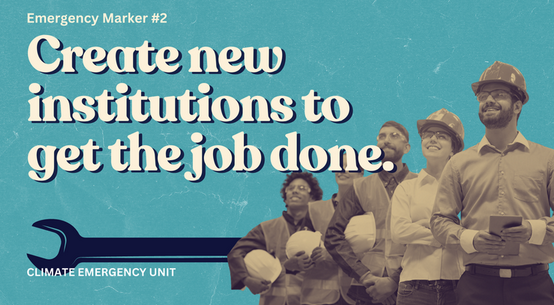
“It’s time to build, strong!” implore the ubiquitous Government of Canada ads now inundating all our media platforms — to build an economy “by Canadians, for Canadians.” Likewise, in Prime Minister Mark Carney’s now famous Davos speech, he stated middle powers such as Canada “must develop greater strategic autonomy: in energy, food, critical minerals, in finance, and supply chains.” The PM spoke of the need to diversify our trading relationships, but was also clear that we must “build our strength at home.”
Welcome words, to be sure. But as numerous critics have rightly noted, Carney’s record is all too frequently characterized by a gap between lofty rhetoric and his government’s delivery in practice.
A key missing piece in our economic resilience plan, not to mention in our moribund efforts to decarbonize our society: modern public enterprises, a new generation of what in Canada we call “Crown” corporations.
I can rightly be accused of fixating on the need for new Crown corps. Why? Because in their absence, the best we can do is indirectly incentivize others to do and build what is needed to get a job done — which, if you were looking for a one-sentence summary of the federal Liberal government’s lackluster climate plan, look no further.
Carney’s overall approach to climate remains firmly rooted in two core policies –– carbon pricing (now only for the industrial sector, with the terms still TBD) and an ever-growing package of climate-related tax credits for companies willing to make energy transition investments (although the juiciest of such credits are reserved for dubious carbon-capture projects). These market-based policies will have some effect, but not nearly at the speed and scale required. The largest beneficiary of them to-date, landing credits worth as much as $15 billion, has been the Stellantis EV battery plant in Ontario. But significantly, this extraordinary outlay doesn’t change the climate equation and create a plant that wouldn’t otherwise exist; rather, it succeeded at the time in landing a plant in Canada rather than the US (with the company showing little gratitude of late, as it caves to Trump’s bully-tactics).
Just two days after the release of the 2025 federal budget last November, federal Environment Commissioner Jerry DeMarco released a report showing the poor take-up rate of these climate-oriented tax credits. No one is coming to our rescue! If we want to rapidly see the mass production and deployment of energy-transition technology, equipment and infrastructure, we are going to have to do it ourselves.
Take the urgent need to build out an east-west electricity grid — all we got in the budget is a 30 per cent tax credit. It isn’t going to work.
This approach can’t work because so much of the climate-related infrastructure we need — high-speed rail, urban transit, renewable energy, electricity transmission — is inherently public.
But it’s not just on climate where the government’s economic strategy is stuck. Carney talks about the need for a “made in Canada” economy, but his whole approach is to cajole and entice the private sector — he’s become encourager-in-chief. Outside some modest housing investments and limited boosts to community infrastructure, the government’s only significant — indeed massive — willingness to directly spend and invest is concentrated on military procurement. In all other economic domains, the government doesn’t appear willing or able to actually invest in new economic entities.
If we are desperate for new job-generating investment — and we are, especially as we seek to insulate ourselves from Trump’s threats — yet reluctant to make public investments ourselves, we are left with few options. Large multi-billion-dollar private investments have shown a bias towards traditional resource sectors — mining, oil and gas — taking us on a path back to a 19th century “dig it and ship it” staples economy.
Failure of political imagination
Over the 5-year mission of the Climate Emergency Unit, I met with dozens of political leaders. They were mostly good people wishing to do good work. They mostly claimed to understand the severity of the climate crisis. And they were for the most part not captured by industry (although sometimes). Rather, my key take-away from these encounters is that what holds them and us back is a failure of imagination; a loss of faith in our collective capacity to do big things ourselves. Consequently, they either failed to consider or could not embrace the need to create brash new economic institutions to tackle the emergencies we face (be it climate, Trump, the housing crisis or what have you).
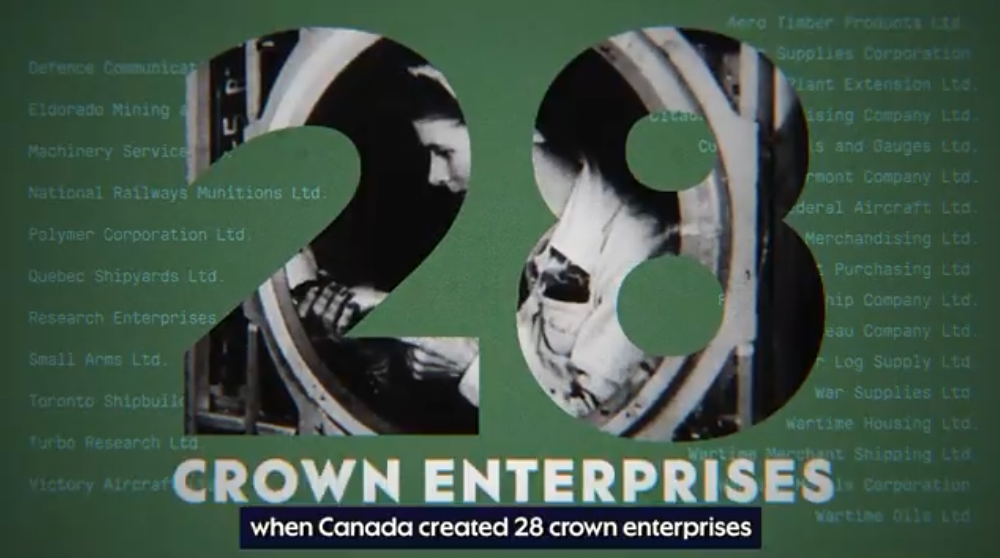
This hasn’t always been the case. During the Second World War, under the stewardship of Minister of Munitions and Supply C.D. Howe, Canada established a stunning 28 new Crown corporations to expedite the mass production of military equipment. Some of these public entities undertook direct manufacturing while others served to coordinate supply chains to prioritize wartime production. Notably, Howe established a Crown corp in each major military sector (planes, ships, munitions, etc.). Why? So that he would know the price of production and was thus able to keep the private contractors honest in their bidding (an approach that finds a historic echo in Avi Lewis’s proposal for “public options” in key economic sectors today).
Like Mark Carney, C.D. Howe was no lefty. Like Carney, Howe came from the private sector, where he had become a wealthy man prior to entering politics, and he was happy to send big government contracts to the private sector. And Like Carney, Howe faced an emergency need to retool the Canadian economy.
But unlike Carney, Howe was in a genuine hurry and when the private sector proved unwilling or unable to quickly produce what was needed at scale, Howe created a new Crown enterprise to do it. All to meet the urgent needs of Canada’s wartime mobilization.
The Trudeau government likewise lacked Howe’s imagination and urgency. Under Trudeau, the government created two new Crown corps of note: the Canada Infrastructure Bank (which is weighed down by public-private partnership requirements and has accomplished very little, a curse that may well plague Carney’s new Build Canada Homes corporation); and, wait for it — the Trans Mountain Pipeline corporation — the agency established in 2018 so that the government, on our collective behalf, could purchase a 60-year-old oil pipeline from Texas-based Kinder Morgan and then build the expansion pipeline that has tripled the volume of bitumen carried from the oil sands to Metro Vancouver. This monstrosity stands near-alone in garnering political ambition.
The failure of imagination was also at play in the government’s response to the COVID pandemic. There was much the federal government got right in that first year, in particular demonstrating a remarkable ability to get emergency cheques out the door. But one thing it did not do was re-create a Crown corporation to mass-produce vaccines (we used to have a globally-recognized public enterprise that did this – Connaught Laboratories – but the Mulroney government privatized it in the 1980s). Instead, Canada shamefully used its economic muscle to outbid poorer countries to secure the vaccine supply we needed, an approach completely at odds with what we did in the Second World War, when we used our public enterprises to serve as an arsenal for our allies in a global effort to confront a civilizational threat. No different today. Are we going to compete for supply of zero-carbon manufactured goods, or help supply others?
A new generation of Crown enterprises
What we dearly need is a whole array of new public enterprises to actually take matters into our own hands and see us build and deploy what is needed at a mass scale; to genuinely become “maîtres chez nous.”
When I have shared the story of C.D. Howe and the Crown corporations he established, I am frequently asked: what would those Crown corporations be today? It’s an excellent question.
Here is my list of some potential candidates for new Crown corporations to meet the climate emergency:
A federal high-speed rail corporation. The original railroads were foundational to the creation of Canada. Why not keep the next-generation ones public? If our population base has failed to make this proposition sufficiently attractive to the private sector, let’s just do it ourselves.
Nationalize an auto plant that is threatening to decamp and have it expedite the production of electric vehicles, with a focus on electric vans, trucks and buses to replace public and commercial fleets. A similar enterprise could focus on electric farm equipment and/or the mass conversion of boats and ships to electric marine batteries.
Renewable energy corporations, likely in every province, that focus on building large-scale renewable projects (solar fields, wind farms, wave/tidal power generation, neighborhood geothermal/heat exchange systems and industrial-scale battery projects). Much like the development of large hydro dams in our past, there is a logic to doing this work publicly. These projects will frequently require public land. And, starkly different from oil and gas, once a project is built, the energy itself is free. Nature, in its bountiful generosity, provides the sun’s rays and the wind and the warmth of the earth, day after day, at no monthly charge to the user, making these activities less attractive to for-profit corporations (in the absence of a large public subsidy). Oil has produced some of the most profitable corporations on the planet. That’s never going to happen with solar.
New provincial public corporations focused on the mass production and installation of electric heat pumps, solar panels and back-up batteries, along with energy efficiency upgrades, at the household level. This would simplify what is currently a very complicated exercise for many homeowners (I say based on personal experience), keep the price down with bulk purchasing and eliminate profit margins from the installation work. (I’ll have more to say on this in a future column.)
A new public housing development corporation that is truly focused on the mass construction of low-income, carbon-zero homes.
Importantly, rather than being an ongoing government expenditure, each of these enterprises can actually make money, earning revenues in monthly fees, rents, ticket fares, or through the sale of the goods and services offered. And each would generate thousands of domestic jobs. They just wouldn’t need to produce a level of profits expected by private investors.
There are no doubt more possibilities worthy of consideration. We just need to approach the challenge creatively. The point is simply this: if something that needs to happen isn’t happening through the market at the scale and speed that the emergency requires, then — through our governments — we can and should damn well do it ourselves.
[For those wanting to dig deeper into this topic, have a listen to the Climate Emergency Unit’s podcast Break In Case of Emergency, with host Erin Blondeau. This episode of a special series on the 6 Markers of Emergency features a conversation with best-selling author Linda McQuaig, former clerk of the Privy Council Alex Himelfarb and myself, discussing the need for new economic institutions, available on Apple Podcasts here and Spotify here. You can also check out the CEU’s video on the 6 Markers of Emergency here.]