
Avi Lewis is the leader the NDP needs now: Why I’m heading off to Winnipeg for my first political convention in 31 years
This is a different kinda post. It’s about why I think Avi Lewis should be the next federal NDP leader.
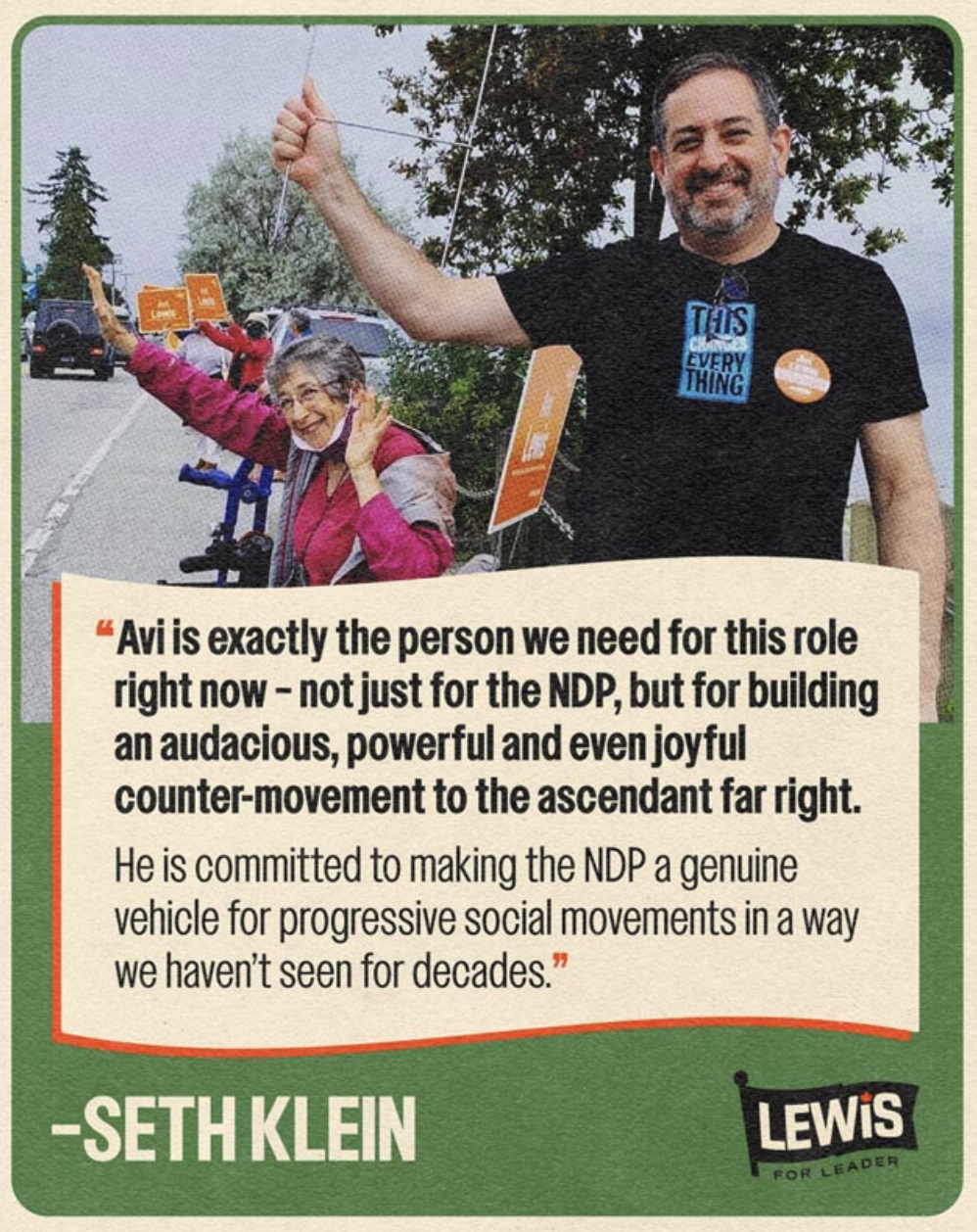
Yes, yes, I know, I’m completely biased. Avi is my brother-in-law. But even if he was not, I’d still be all in. I am completely convinced that Avi is exactly the person we need for this role right now – not just for the NDP, but for building an audacious, powerful and even joyful counter-movement to the ascendant far right (and a federal Liberal party chasing after them).
Never say never
First, a bit of personal political history…
The new leader will be announced at the NDP federal convention in Winnipeg on March 29, and I’ll be there to cheer Avi on. It will be my first time attending a political convention in 31 years.
That last one was the federal NDP convention in 1995. I was among hundreds of young delegates attending in support of Svend Robinson’s leadership bid. (Fun fact: at age 27, I was one of Svend’s four official nominators, along with the late labour icons Nancy Riche and Dick Martin, and the beloved late MP Marion Dewar.) That 1995 assembly was a highly charged gathering and unfolded in unprecedented fashion. It was also, quite simply, an awful experience, after which I vowed never to attend one of these cursed events again. Indeed, the outcome and process were so bitterly disappointing, I was far from alone. Many young people who rallied to Svend’s banner all those years ago were turned off the NDP for decades (an echo of what occurred for an earlier generation of young Waffle activists in the early 1970s, who were similarly alienated from the party for decades; when it comes to galvanizing young people, the NDP has a long legacy of shooting itself in the foot). But, here I go off to Winnipeg, cautiously optimistic that this time will be different.
What made that 1995 convention so unusual? For the history buffs among you, a brief recap:
At all conventions, the chosen leader must secure a vote of 50% plus one (usually, although not always, attained after multiple rounds of voting). The 1995 convention was one of the last “delegated” conventions; meaning, rather than every party member getting a vote (as will happen this month), riding associations and unions sent delegates to the convention, who in turn elected the leader. Svend, representing the party’s left flank, went into the convention in first place with a plurality of pledged delegates, but not a majority. In second place (representing the more “right-wing” of the party) was Lorne Nystrom. In third place was the late Alexa McDonough (the more “centrist” candidate).
The expectation and hope of those of us supporting Svend was that, when Alexa fell off the ballot, her supporters would split, and enough of them would come over to Svend to take him over the 50% threshold. It didn’t play out that way.
Going into the convention, some of the more establishment forces in the party and a couple of the more conservative unions were officially backing Lorne. Thing is, much as they liked Lorne, this sentiment was secondary to their strong aversion to Svend. The narrative spun by these folks was that Svend was “too radical” and “too divisive”; he was “too much of an environmentalist” and would thus alienate unions from the resource sector; he was “too tied to outside social movements.” Sound familiar? Wishing to stave off a Svend victory, a contingent of these folks quietly shifted their support from Lorne to Alexa.
When the results of the first ballot were announced and displayed on the big screen, the order was not Svend, Lorne, Alexa, as most expected, but rather, Svend, Alexa, Lorne. And within an instant, everyone knew the jig was up. With Lorne forced off the next ballot, all present understood that none of his supporters would be coming to Svend.
The unprecedented part? There was only ever one ballot. Svend won it. And then conceded. And Alexa was declared the new leader of the NDP.
In the basement of the convention centre, hundreds of Svend supporters – dominated by idealistic young delegates – gathered to debrief. We were furious; our dreams of an audacious and proudly socialist party with deep connections to progressive social movements dashed.
Another bit of NDP convention history. Back when Jack Layton ran for the leadership in 2003, only two sitting NDP MPs endorsed him – Svend Robinson and Libby Davies (most of the caucus supported the late Bill Blaikie). Yet, as we all know, Layton won handily regardless and would go on to become the most politically successful leader the NDP has ever had and a much beloved figure within the party. Notably, Svend and Libby were also among the early endorsers of Avi’s leadership bid.
But enough history – let’s return to the present.
Climate is a key differentiating issue
For the record, there is lots to like about all the leadership candidates. All have brought great ideas to this contest. Personally, I’ve been particularly impressed by Tanille. And it’s my view that Heather has been an outstanding foreign affairs critic, notably her strong and clear voice condemning the genocide in Gaza and now the illegal and precipitous attack on Iran (or course Avi has been equally strong on these matters). There are many areas of broad agreement among the candidates. But there are some important differences too.
As most of you reading this know, I’ve spent recent years primarily focused on how to confront the climate emergency. And friends, Avi is a genuine climate justice champion.
Have a look at Avi’s Green New Deal climate platform here.
As you will see, this is the most robust, comprehensive and hopeful climate plan we have ever had on offer from a federal leadership contender. It lays out both an ambitious plan for the positive things we must build and the centrality of just transition for workers, but also offers clarity about what we must stop doing; namely, investing in new fossil fuel projects.
Avi has a proven track-record on climate justice spanning decades, from his film This Changes Everything, to his co-authorship and leadership of the Leap Manifesto, to the visionary short video he made with AOC – Message from the Future (Avi wrote the script – if you’ve never seen it, treat yourself to it now, and join the millions who have).
Avi’s bold climate positions have come under fire from other leadership candidates, but usually cryptically. When other contenders rebuke Avi for criticizing provincial NDP leaders, that’s code for the fact that Avi clearly opposes new oil and gas projects, even when those projects are being advanced by NDP provincial governments or wings. What’s really at issue is Avi’s insistence that we tell the truth about the need to phase out fossil fuels. Conversely, the other leading contenders – Rob Ashton and Heather McPherson – like far too many political leaders, are too willing to peddle a disingenuous line, namely, that we can be serious about tackling the climate crisis while still abiding new fossil fuel infrastructure.
It's easy to say what you are for when it comes to climate action – high-speed rail, renewable energy, inter-provincial electricity upgrades. It’s far harder – but a much more telling sign of leadership – to say what you oppose, namely new pipelines and LNG.
In response to the critique that he should not publicly rebuke provincial NDP positions, Avi has stated, “We can stand together as New Democrats while having democratic disagreements around crucial issues of public policy.” I agree. (And I say so as someone whose wife is a cabinet minister in the BC NDP government.) When people of differing views can all find a home in the NDP, and all hear their views articulated by various leaders within the party, the tent grows larger. Conversely, when people who hold views that diverge from the leader are told to bite their tongues, they leave.
Meeting emergencies at scale
Like many of you, I’ve been struggling with our politics in recent years. The solutions on offer just don’t seem congruent with the scale of the crises we face – the affordability crisis, the housing crisis, the poison drug crisis, and of course the climate crisis. And it’s been brutal watching the far right capitalizing on people’s despair.
We desperately need something better – an unapologetically brash, left populist alternative. Those are the campaigns in other jurisdictions that have been successfully thwarting the populist right. And that’s the kind of campaign Avi has been running, and the kind of leadership he brings. Avi is the only one talking about new public options – new crown corporations in key domains. A defining campaign slogan: “Real solutions that actually match the scale of the crises we face.”
Avi also has an extraordinary gift in his ability to clearly articulate the challenges we face and the solutions we need, and to connect with people. He is a master communicator. As a broadcaster, he spent decades figuring out how to explain political and policy ideas to a broad audience (and to a young audience, back in his early days at Much Music), but he also has policy depth. He brings to this a profound knowledge of the history of progressive social movements, which informs his politics today. And he is committed to making the NDP a genuine vehicle for progressive social movements in a way we haven’t seen for decades.
So, go check-out and explore the campaign website: https://lewisforleader.ca/. It will inspire you.
This NDP leadership race has the potential to be a transformative moment. It matters who wins.