
On three years of genocide and rising antisemitism: Reflections on a different emergency (with thoughts for fellow Jews in Canada)
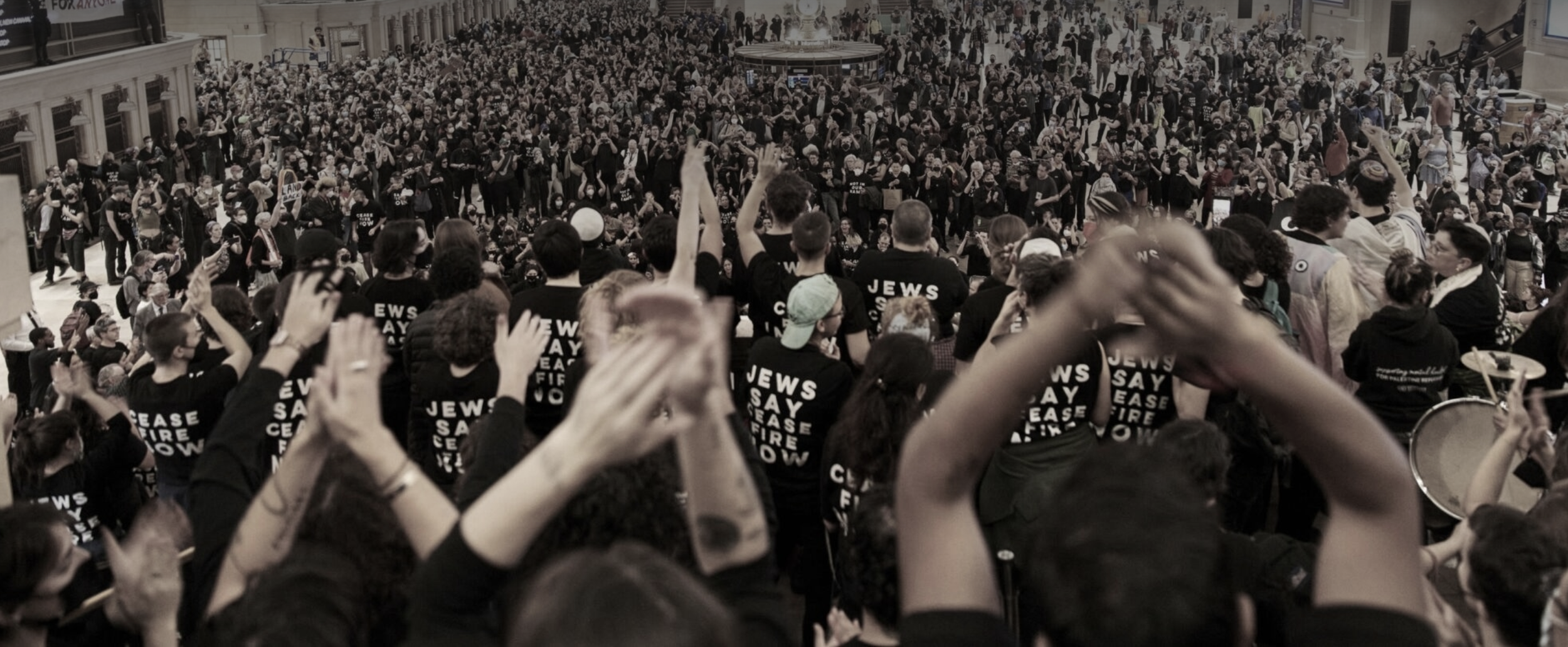
From the website of Jewish Voice for Peace, photo of Jews protesting the war on Gaza and demanding an immediate ceasefire in New York City’s Grand Central Station, in November 2023.
Next week, unfathomably, marks the 3rd anniversary of the horrific October 7th Hamas massacre, and three years of the monstrous and heart-wrenching genocide that Israel has inflicted upon Gaza.
I occasionally post and share items on social media about the horrors that have occurred in Gaza over the last three years, but I haven't written a column about the subject. My instinct is to only write about topics where I claim some level of expertise (a hangover from my many years working with a public policy think tank).
But today, I'm breaking with that to share some personal reflections about the genocide of Palestinians, Israel, and the rise of antisemitism.
Like all Jewish people, I've lost a few friends over this topic. And I expect I'll lose a few subscribers as a result of this piece. But a foundational assumption of this newsletter is that one cannot stay silent in the face of an emergency and humanitarian crises.
Too often, when I find myself in conversation with fellow Jews on this topic, the discussion feels oddly out of whack/balance. Most of it ends up deliberating on the rise of antisemitism. We are indeed witnessing a rise in antisemitic attacks in Canada, the US, Australia, much of Europe – of that there is no doubt. But here in Canada, thankfully, no one has been killed in these attacks. Canada has, in contrast, seen the murders of Muslim people in at least two Islamophobic hate crimes in recent years. And in Gaza, over 74,000 are now dead, one third of them children born since the last election held there. Over the last three years, Gaza has been one of the most dangerous places on earth to be a child, a journalist, a teacher, a health professional, all at the hands of a purportedly “liberal democratic” state. Israel claims to do this in our name.
While a supposed ceasefire has been in place since last October, Israel continues to launch strikes that have killed over 1,100 more people, Israel holds over half of Gaza and no reconstruction has occurred. Life remains miserable. Now the death and destruction extends into Lebanon, Iran, and the West Bank, where Palestinian life is under severe and constant attack. Given this, how then does so much of our discussion among fellow Jews end up focused on antisemitism in Canada?
My Jewishness is important to me. I believe the Jewish tradition of Tikkun Olam (the commandment to repair the world) from which I come informs my politics and my social justice values. I went to Jewish elementary school in my youth, learned Hebrew and Yiddish, had a formative Bar Mitzvah, and I have travelled in Israel three times.
But, Jewish life is not more precious to me than that of others. While I of course care about and mourn the loss of Jewish life, I do not mourn it more than the loss of Palestinian life, or other human life. (And I believe this value is also part of the inheritance of Tikkun Olam, which is also precious to me.)
Too many in the Canadian Jewish community are singularly focused on antisemitic attacks here, reinforced by the recent terrifying Yom Kippur attack in Belleville. But what is the political/policy action believed to be needed or lacking? These attacks must be condemned, of course. Then what? Stronger hate crime laws? We have those. More police protection at all Jewish cultural sites and events? Maybe. But none of these, to my mind, will actually reverse the rise of antisemitism.
It is the actions of the Israeli state that are, in the main, what has unleashed the rise in antisemitism (even a recent B’nai Brith report acknowledges that this is a significant factor). When we in the West fail to vigorously condemn these actions, and when our own government fails to act forcefully to sanction such Israeli state action, the Israeli government feels able to act with ever more impunity – and the antisemitic reactions escalate in turn.
Too often, mainstream Jewish organizations contend that while Israel and Jews may not be identical, they are inseparable, and they insist that Israel must be defended “as a Jewish state.” And yet, ironically, the more Israel pursues its genocidal policies with impunity, the more support for Israel among diaspora Jews declines, especially among younger Jews.
In the UK (which has seen some horrific antisemitic attacks of late), this trend is clear. The BBC reported last December:
“Data from the Institute for Jewish Policy Research (JPR), a UK think tank, gathered before the Manchester attack and published in October, suggests that there is a generational divide in opinion among British Jews when it comes to views about Israel.
The study of 4,822 British Jews over the age of 16 suggested that the overall number identifying as "Zionist" was 64%, but among the 20-30 age group, only 47% did. Meanwhile 20% of that age group describe themselves as "non Zionist" and 24% as "anti-Zionist". (It was left to respondents to decide how to interpret those labels.)”
In a similar vein, in December 2024, the New Israel Fund published the results of a large survey of Canadian Jews. Among their findings: “While 94% of Canadian Jews support Israel’s right to exist as a Jewish state, only 51% consider themselves Zionists.” I’m certain the number is much lower for younger Jews, and the overall numbers have likely declined since December 2024 (and for some, Israel’s actions are pushing them away from Judaism itself, as more and more young people only see a dominant regime and community with which they do not wish to be associated).
In my view, the best way to confront the rise in antisemitism is when we, as Jews, condemn when the Israeli state perpetuates genocide and acts monstrously and contrary to international law.
The Globe and Mail says the NDP has an “antisemitism problem.” Yet the federal NDP has recently elected both a proud Jewish leader and a Jewish party president. Hmm. The UK Green party is similarly accused of having an antisemitism problem, yet interestingly, it too has a new Jewish leader, Zack Polanski, who like Avi Lewis here, is strongly critical of Israel. More recently, UK foreign secretary Ed Miliband, who is also Jewish, gets accused of self-hatred for his welcome moves to impose economic sanctions on Israel.
In my view, these leaders like Avi and Zack are doing far more to tackle antisemitism than any of the policy/political measures many in the Jewish community seem to think are lacking. Because through their clear and unequivocal denunciations of what Israel is doing, they unravel the lies of the antisemites – they make clear that it is not “the Jews” who are to blame for these horrors we have all witnessed, but rather, the leadership of Israel. These progressive Jewish leaders (and groups like Independent Jewish Voices in Canada and Jewish Voice for Peace in the US) defang the hate. Through their deeds and words, they make real that Jews are not a monolith, and that Zionism is not inherent in Judaism.
I don’t believe there is ever a legitimate justification to attack civilians, most of all children, by anyone, whether it be Israel or Hamas. But I also think the best way to stop the violence is when the world imposes real consequences. The South African comparison is apt here – the fight against Apartheid could have taken a violent/armed path (and sometimes did) or a peaceful one. But because the world was willing to join in the latter – imposing economic sanctions and divesting – the former was relinquished.
The Jewish people have suffered numerous historic collective traumas, most recently the Holocaust. Understandably, this history leaves a social and epigenetic echo. The challenge, however, is how to honor this experience without letting that echo cloud our own ability to see clearly what is before our eyes in the present.
In the Jewish elementary school I attended, we were indoctrinated into an ideology that perpetually sees Jews as the victim (something that, historically, was far too frequently true). But it is largely not true in the present. Today, in the main, our people are not the victims, and in Israel/Palestine, Jews are the oppressor. We need to adjust accordingly.
The lesson of Tikkun Olam is not that the terrors of genocide should never again be permitted to happen to us. Rather, it is “never gain, to anyone.”