
How to blow open public imagination for meeting emergencies at speed and scale: 3 ways to unleash our collective sense of possibility
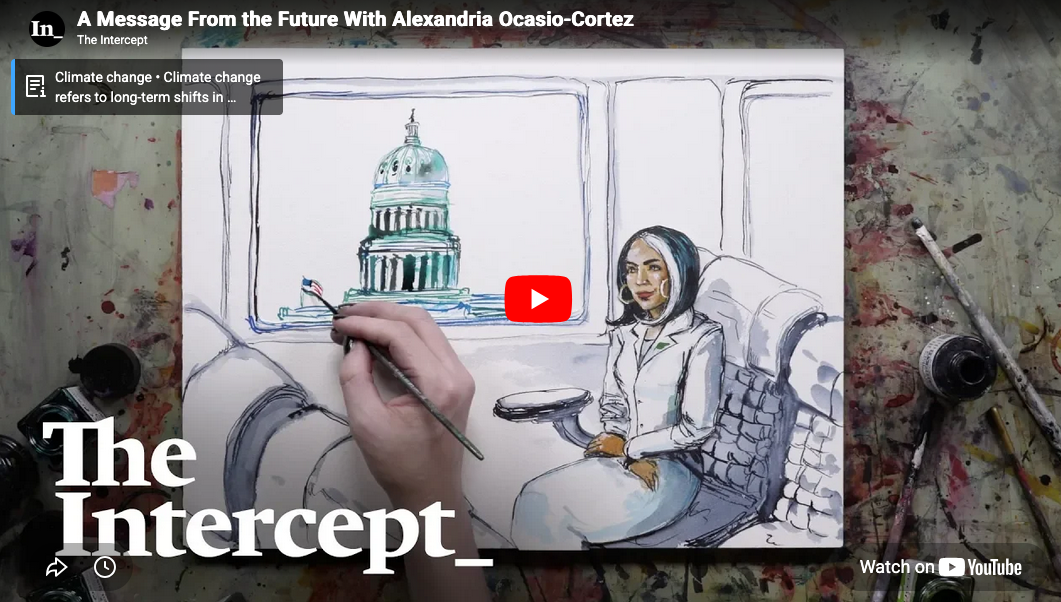
A Message from the Future, the 2019 video produced by The Intercept, sought to expand our imagination, offering a picture of what it might look like when we implement a Green New Deal. Full video here
Those of you who follow my work have probably heard me say before that a key barrier holding back genuine climate emergency action – or, in truth, action at speed and scale to confront any number of crises we face – is a ubiquitous failure of imagination.
I find myself frequently invoking an observation by one of my mentors, Alex Himelfarb, former clerk of the Privy Council (and likely the only left-wing head of the federal public service we’ve ever had), who told me, “The most insidious legacy of 45 years of neoliberalism isn’t the tax cuts, or the spending cuts, or the deregulation or privatization, or the corporate-serving trade agreements. Rather, it is the sapping of our imagination – of our collective faith in our capacity to do big things together.”
Alex’s insight was continually reinforced by my own experience campaigning with the Climate Emergency Unit (CEU) over the last five years. Over and over again, when meeting with policymakers (elected leaders, senior political advisors or senior civil servants), I mostly encountered people of good will, who wanted to do the right thing, who accepted the climate science (if not always its true implications), and who were not captured by industry (although sometimes). Rather, the wall I continually ran up against was a failure of policy imagination. But this isn’t only true of political leaders. It is just as often true of civil society leaders and organizations within our own movements. After all, none of us find it easy to resist dominant assumptions about how the economy “must” function. Our curse is that our sense of possibility is contained by what we know.
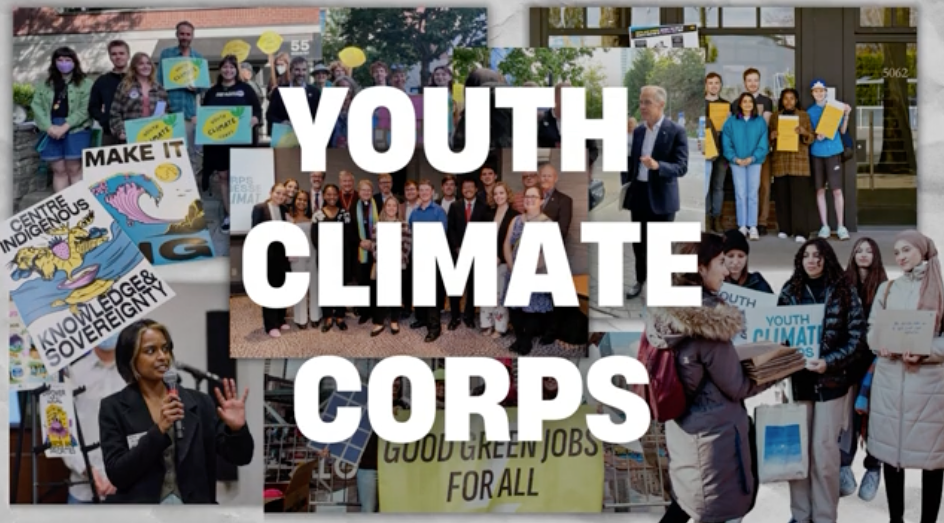
Why is it so hard to convince political leaders to embrace audacious new public policies like a Youth Climate Corps? Image from the Climate Emergency Unit.
For example, when the CEU sought to urge political leaders to create brash new public programs (such as the Youth Climate Corps or a Just Transition Transfer), we instead encountered leaders trying to figure out what non-profit or private organization they could cut a cheque to – they were unwilling or unable to embrace their own leadership in a time of emergency – a “cult of impotence,” as author Linda McQuaig dubbed it in her 1998 book of that name. Similarly, even when governments are prepared to spend billions of dollars, these expenditures almost always take the form of tax credits, loan guarantees or even more wonky ideas like “carbon contracts for difference” – all efforts to incentivize private sector actors to make climate-oriented investments – rather than a willingness to spend big on public infrastructure, or grabbing the bull by the horns and establishing new public corporations to urgently build and deploy what the climate crisis requires. Finding political leaders willing and able to channel the spirit of Canada’s Second World War-era minister of military production C.D. Howe proved few and far between.
How then can we blow open our collective imagination?
I’d suggest there are three ways to do this, all involving storytelling at some level, and frequently aided by art:
Option #1: Excavate a historic reminder
The task here is to pull from the recesses of our collective memory examples of when we did great things together, and truly moved at speed and scale.
This is, of course, what I sought to do in my book A Good War: Mobilizing Canada for the Climate Emergency, drawing lessons from Canada’s Second World War experience to remind us of what it looked like to rapidly and completely retool the economy and mobilize the whole of society, back when we last confronted fascism 85 years ago.
The same technique is at play with the campaign in many countries for a Green New Deal, which is of course invoking the historic memory of Roosevelt’s 1930s-era New Deal, another time in which a government created brash new public programs and made massive new public investments in order to banish the despair and unemployment of the Great Depression. Canada, sadly, never had a New Deal. The Second World War mobilization was, in effect, our New Deal; hence its particular resonance in this country.
Option #2: Tell stories from the future
The goal in this case is to tap the imagination of some of our best novelists and filmmakers, seeking to bring into focus a picture of what it might look like a few years from now, when we have finally started to take truly transformative action.
This is what near-term science fiction writers do, like Kim Stanley Robinson in The Ministry for the Future or Cory Doctorow in The Lost Cause, two examples of books I’ve read in recent years that do a wonderful job of describing how things have gotten simultaneously worse and better in a world confronting the climate crisis. More often, climate-themed science fiction (novels and films) is purely dystopian. But the books I am referencing, while being clear-eyed about the escalation of climate-induced disasters, also depict governments collaborating to adopt new policies and programs to end fossil fuel use that seem politically impossible in the present.
Similarly, this is the technique employed by Molly Crabapple (artist), Avi Lewis (writer, and yes, that Avi Lewis) and Alexandria Ocassio-Cortez (narrator and co-writer, and by day US congressperson and leader of the progressive “squad”) in their super-popular 2019 video A Message from the Future, which has had over 1 million views on YouTube. The video imagines a time a couple decades from now, when events have compelled a progressive government to implement the core planks of a Green New Deal. As that video concludes, “We can be whatever we have the courage to see.” If you haven’t seen this 7-minute video, treat yourself to it now.
Option #3: Tell stories / give examples from other places that are kicking our ass
Polling tells us it is important to Canadians that we be leaders in tackling the challenges of our time. The bad news: when it comes to confronting the climate crisis, far too many of us mistakenly think we are!
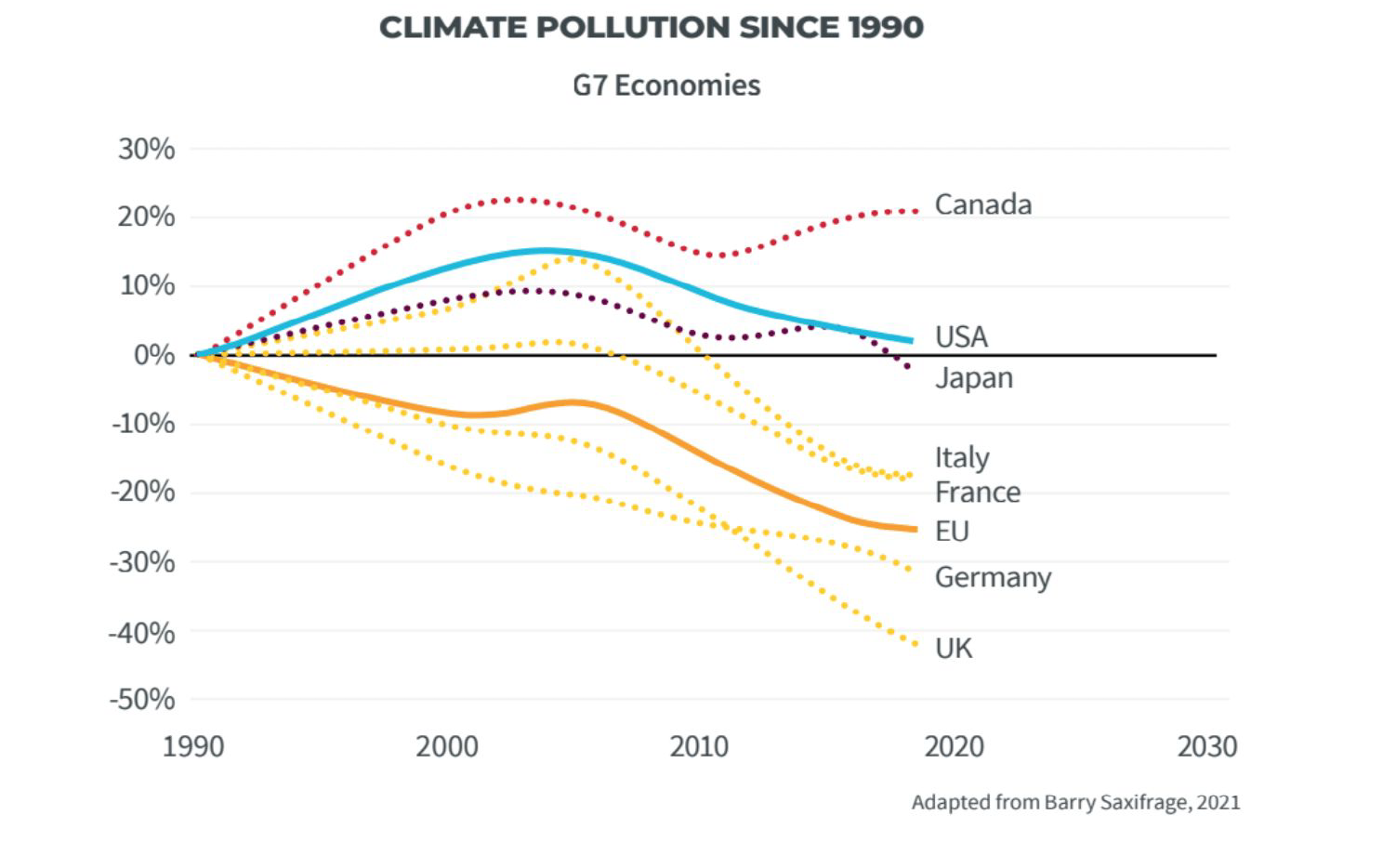
The sad truth, however, as revealed by this chart from Barry Saxifrage (columnist with Canada’s National Observer), is that Canada’s record on lowering GHG emissions is comparatively abysmal. We are laggards. Much of the world – and every other G7 country – is kicking our sorry asses.
Far too often, our perspective is so insular. We rarely follow what is happening in other provinces, let alone other countries. And even when we do look beyond our borders, we remain narrowly focused on North America. The problem with that, however – but also the good news – is that North America is currently an aberration in its climate inaction. Much of the rest of the world is leaping ahead in the race to get off fossil fuels.
And so, we need to share stories and news about all those other countries that are leaving us in the dust. This is exactly what Bill McKibben does in his latest book Here Comes the Sun, detailing the exponential growth in solar power production happening around the world – last year the world produced a third more solar power than the year before! But you’d never know it here in North America.
Sharing news from abroad is what Chris Hatch often does in his weekly climate news round-ups, or what the Energy Mix news service frequently does. Internationally, The Guardian’s climate coverage does this very well, as does the UK-based Carbon Brief news service. It’s important to subscribe to these services, so you can receive and share stories about how other places are acting on the transition at a much fast clip than is Canada or the US.
Dire as things are, we all need to be alive to the hopeful trends: China looks to have peaked its GHG emissions, years ahead of schedule, and is producing a coal-power plant’s worth of solar panels every day; Europe is driving down emissions much faster than Canada; in Norway, 97 per cent of new vehicle sales are now zero-emission; in the UK, emissions are now lower than at any time since the start of the industrial revolution in the late 1800’s; Pakistan, Vietnam, and the Philippines are all cancelling plans to import LNG, turning instead to solar; and around the world, the adoption of renewable energy is exploding.
**
So, there you go, friends. Tell stories from our past, the future, and other places. One way or another, let’s bust open our collective imagination, so we can resolve to meet the emergencies we face, and mobilize around solutions as big as the crises we confront.
Let’s break the silence on the climate crisis!