
Carney’s sovereign wealth fund gets it backwards
[The following piece was also published by Canada’s National Observer here.]
Don’t make investments through the looking glass.
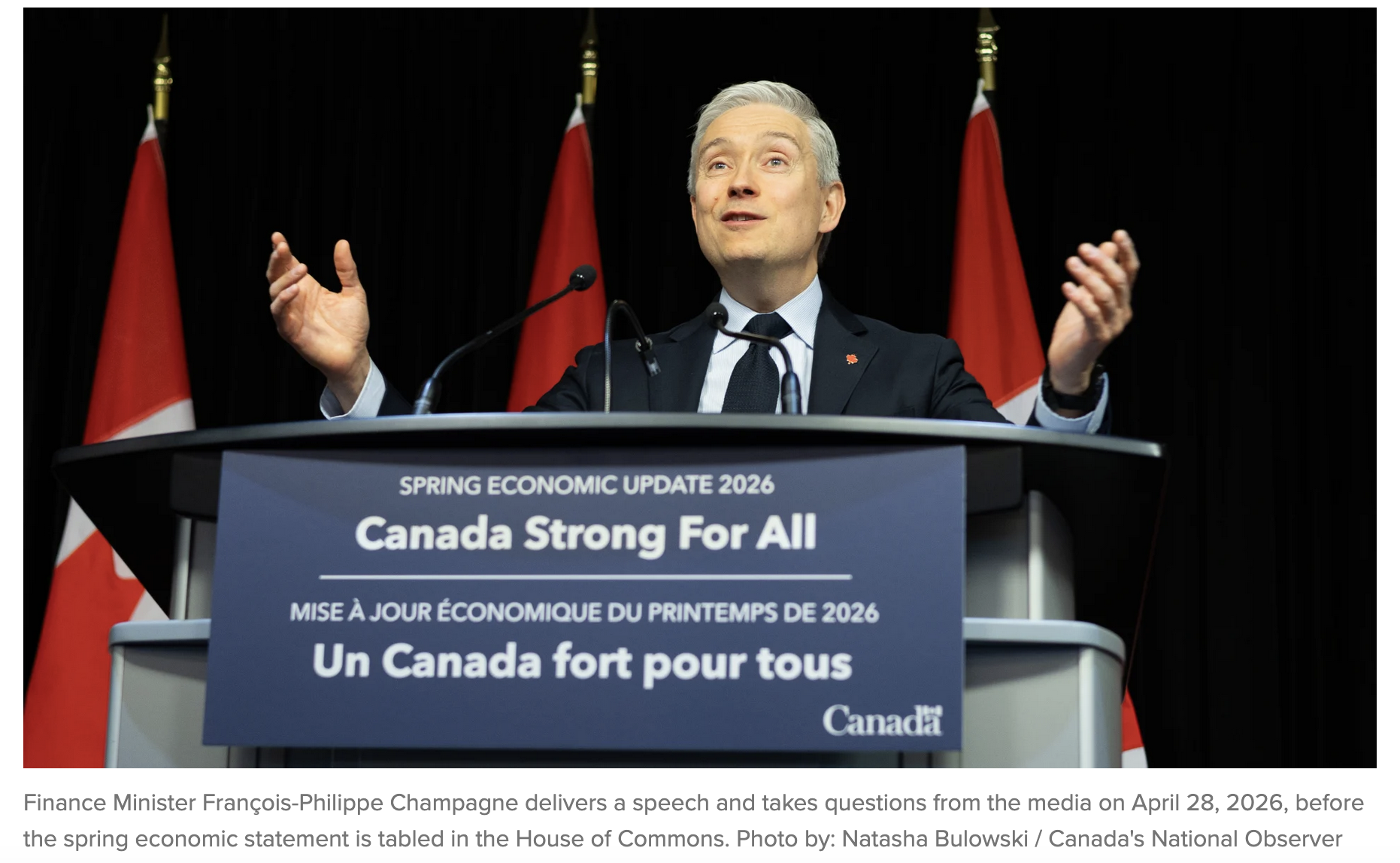
By now, most of you reading this column are aware of Prime Minister Mark Carney’s announcement earlier this week that the government is launching a sovereign wealth fund (entitled the Canada Strong Fund).
There is, in theory, nothing wrong with such an idea. Indeed, the logic behind such a fund is quite sound.
The problem is that, in practice, the Carney government appears to be proposing a mirror reversal of what is generally understood as the guiding premise for these funds, both in how it is capitalized and in what it invests.
The basic idea of a sovereign wealth fund is that when a government has large but time-limited revenues — most often derived from “Crown-owned” but finite oil and gas resources — then rather than spending those revenues on current operating programs, it would be wise and prudent to direct those funds into a long-term state-owned investment fund.
The earnings from such a fund can then be used to: a) finance public programs and services long into the future, to the benefit of subsequent generations, well after that finite resource is gone; and b) invest in new economic endeavors that move the economy away from an over-dependence on finite natural resources, in anticipation of the day when those industries have wound down.
While details of the new Canada Strong Fund remain scant, early signs are that the Carney government’s fund will be doing precisely the opposite. Rather than being capitalized by oil and gas industry income — even now with the industry about to reap record windfall profits of as much as $100 billion this year in the wake of the Iran War — and using that money to invest in the post-carbon economy, it appears the federal government plans to capitalize the fund with public money and use it to invest in “nation-building projects” that have been referred to the government’s Major Projects Office, which means at least a chunk of the investments will be used to subsidize oil and gas industry projects.
As Sierra Club Canada warned, “We're deeply concerned it is actually a way to use taxpayer money to back oil and gas expansion — like a new west coast oil pipeline and LNG export projects — rebranded misleadingly as a ‘sovereign wealth fund.’” Given that, as CNO has reported, this week’s Spring Economic Update included two new subsidies for oil and gas — one for carbon capture and use for enhanced oil recovery and one for the LNG industry — they are right to be worried.
You should be, too.
A brief history of the Norway and Alberta funds
In his announcement of the new Canada Strong Fund, Carney specifically referenced Norway and its sovereign wealth fund. And well he should; Norway’s fund is widely viewed as a smashing success. Less well known is that Norway’s fund was actually modelled on the previously established Alberta Heritage Fund. In both cases, the founding logic was as described above.
Peter Lougheed, the late Conservative premier of Alberta from 1971 to 1985, oversaw a huge expansion of the province’s oil industry. But he also had considerable foresight and was keen to ensure the industry paid its fair share for extracting what was a publicly-owned resource. Consequently, he set royalty rates at a suitably high level (ignoring much industry squawking) and used some of those revenues to create the Alberta Heritage Fund in 1976, a public savings fund whose earnings could help diversify the economy and meet the collective needs of Albertans into the future, long after the oil ran dry.
This public innovation became a global model, most notably for Norway. After oil and gas was discovered in the North Sea, Norway (whose population is only slightly larger than Alberta’s) sent bureaucrats to Alberta to study the Heritage Fund, leading to the creation of Norway’s sovereign wealth fund in the mid-1990s. But how these two jurisdictions have managed their respective oil wealth makes for a tragic study in contrasts.
A political consensus emerged in Norway that the oil industry and its wealth needed to be managed in the public interest. Unlike in Alberta, where the oil industry is in private (and indeed majority foreign) hands, in Norway, the state itself owns a majority of the industry. In Alberta, after Lougheed’s retirement, his successors began hacking away at the province’s royalty rates and corporate taxes — they now rank among the lowest among petro-states — and no subsequent Alberta premier added anything of note to the Heritage Fund endowment.
Its value today stands at about $32 billion, equivalent to roughly $6,500 per person in Alberta. In contrast, the Norwegian government has continued to plow earnings from its oil development into its collective savings fund. Their sovereign wealth fund now sits at about $3 trillion Canadian dollars — an astonishing amount that is equivalent to about a half a million dollars for every individual in Norway, giving that country an extraordinary capital pool from which to fund a transition off fossil fuels. That’s what it might have looked like, had Alberta’s government truly stewarded this resource in the public interest. Instead, oil and gas companies in Canada have made off like bandits.
A better approach
It's not all bad news this week. The idea of inviting individuals to invest in the new Canada Strong Fund through the issuing of some sort of bonds is positive, provided there is a rethink of the investment plan. Frankly, there have been too few opportunities for ordinary people to contribute to the nation-building projects that we really do need, namely those that will catapult us into the electro-economy of the future.
As for where the bulk of the capitalization should come from, the federal government doesn’t have the option of using resource royalties as the Alberta and Norway funds did, as in Canada these come under provincial jurisdiction (although in truth this royalty income should also be shared with the Indigenous nations on whose territory resources are extracted). But the federal government does have taxation options at its avail. The most obvious in this case would be a combination of a windfall profits tax on oil and gas producers and/or an export tax on oil and gas exports to the US. Both of these have the potential to endow a new sovereign wealth fund with much more money than the initial $25 billion being proposed by the Carney government.
As the global energy transition unfolds, investing public money in fossil fuel projects may well leave Canadians holding the bag for what prove to be stranded assets of little value. A couple weeks ago, the great climate champion Bill McKibben came through Vancouver, and I had the good fortune to catch his public talk. He was, notwithstanding the current wars and unravelling of his country, in an unusually buoyant mood.
It is the dramatic shifts in energy economics and the resulting explosion in renewables that had McKibben in good spirits. As he explained, he’s been in the climate fight for four decades. For almost all of that time, the struggle for climate activists has been to make fossil fuels more expensive, in order to give more costly renewables a fighting chance; hence the multi-year efforts to institute carbon pricing and to press for divestment.
“But in the last 12-18 months,” McKibben stated, “that’s been turned on its head.” The cost of renewables — solar, wind, batteries — has dropped so dramatically across most of the world, they are now the more cost-effective investment, and the global market is rapidly shifting accordingly. Oil and gas investments, on the other hand, are now only “economic” with the help of public money (and even then, the long-term economics are dubious).
And in such a world, using a brand-new public wealth fund to extend the life of an otherwise sunsetting sector is completely backwards.