I lost my dad last week: Some memories and reflections on the passing of Michael Klein
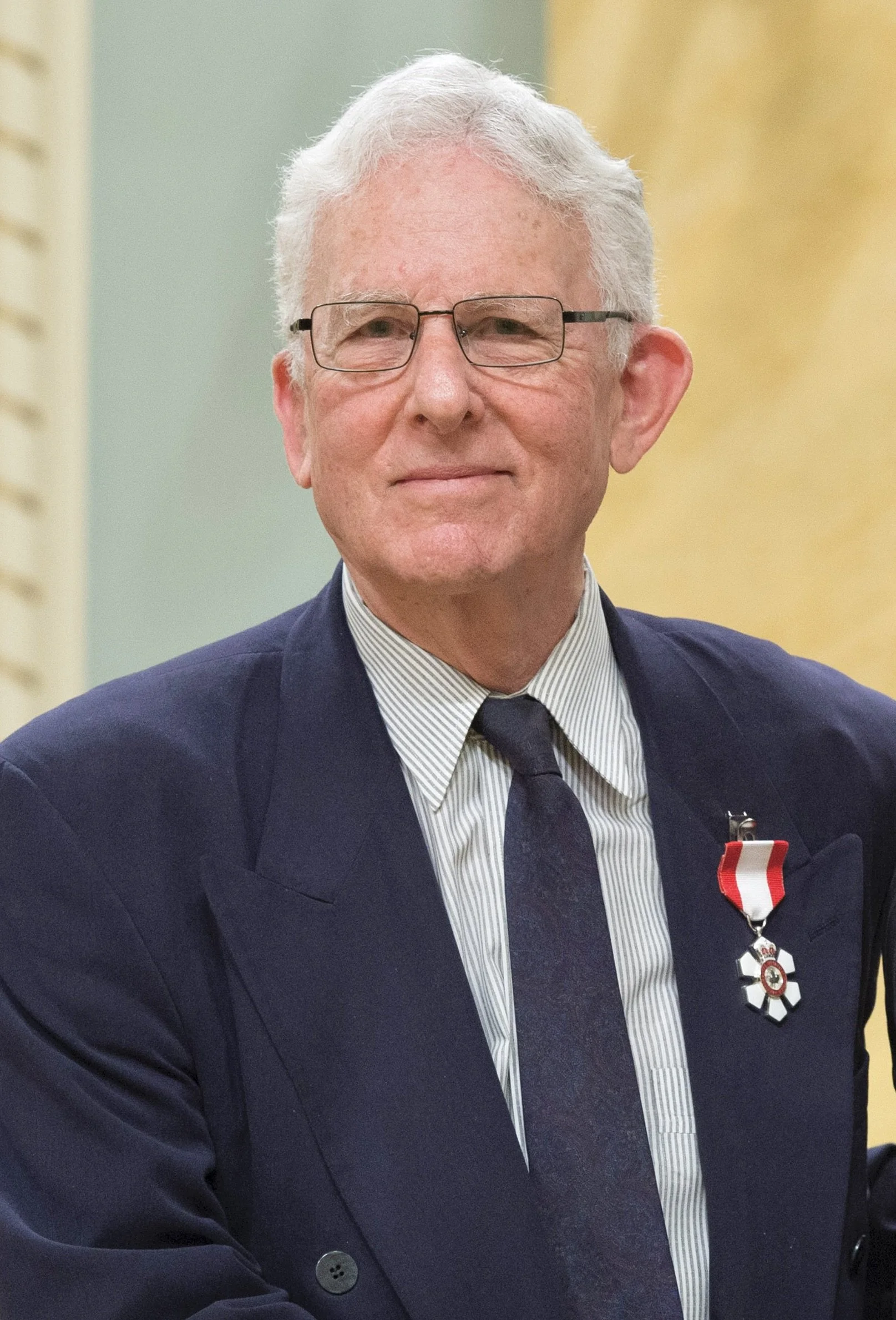
My father, Michael Klein, when being appointed as a member of the Order of Canada in 2016.
I lost my dad last Wednesday.
Pasted below is an obituary my sister Naomi and I wrote this weekend (helps to have a sister who’s a pretty good writer 😉). The obit, along with a bunch of other photos and memories, is also posted here.
But first, wanted to share a few other personal reflections.
I didn’t follow my dad’s footsteps into medicine. But he was also passionate about research; evidence-based research that challenges the status quo establishment, and right from the get-go, research that went upstream to examine the public policies that shape our experiences and choices. He was dead set on changing policies and practices that needed changing. I suppose I did follow him on that path.
He was drawn to public health. While still a medical resident in Montreal at the time of my birth, he had a child patient who died of lead poisoning. Like a detective, he set about finding the source of the lead, finally discovering that it resided in the glaze used in pottery from which the child drank. That investigation changed how glazes are made, and resulted in dad’s first published paper – in the New England Journal of Medicine no less – and he never stopped publishing research until he died.
He saw being surrounded by strong feminist women – as I am blessed to be – as a gift, not a threat. He led teams, as I have too.
Our relationships with our dads are always complicated, and I sometimes found my father hard to deal with. But foundationally, he was a good man, one link in a legacy of social justice champs.
And, in a crisis, dad was the guy you wanted in your corner – calm, clear-headed, creative, completely dependable, and determined to shake the system until a problem was resolved. We’re gonna need more of such people in this era of emergencies.
**
Michael Klein OBITUARY (1938-2026)
Dr. Michael C. Klein, died June 10, 2026, one week shy of his 88th birthday.
Michael was a pioneering family physician and medical researcher who had a lasting impact on maternity care in Canada and beyond. He was head of a McGill teaching centre and the Department of Family Medicine at the Jewish General Hospital in Montreal for seventeen years, and head of the Department of Family Practice at BC Children’s and Women’s hospitals in Vancouver for ten years. He was Professor Emeritus of Family Practice at the University of British Columbia and senior scientist emeritus at the BC Children’s Hospital Research Institute in Vancouver. For his work placing maternity care at the heart of family medicine, he was appointed a Member of the Order of Canada.
Michael was born in Los Angeles, California, the son of Anne and Phil Klein, who raised him in a socialist, secular Jewish home, surrounded by art and activism. His father was a cartoonist and among a small group who started the union at the Walt Disney company and led a long strike there just prior to the US joining WWII. Among Michael’s earliest memories was, at age 3, sitting on a motorcycle outside the gates of the Disney studios in Burbank California, and shouting “scab” at everyone who attempted to enter. After the strike his family returned to the East Coast, and Michael grew up mainly in Newark, New Jersey.
Michael and his wife Bonnie, with whom he was married 59 years, immigrated to Canada twice. The first time was under duress in 1967 as Vietnam War resisters, when Michael refused to serve as an officer in the US Army Medical Corps. The second time was by choice in 1975, this time drawn by Michael’s desire to work in Canada’s public healthcare system and by the National Film Board, where Bonnie spent many years as a documentary filmmaker. In all cases, Canada beckoned because of public policy choices that distinguished this country from our Southern neighbours.
Michael did his undergraduate degree in political science at Oberlin College in Ohio, and then attended medical school at Stanford University in California. While still in medical school, he lived and practised medicine for many months in both Chiapas, Mexico and Ethiopia. His early experience working with midwives in Ethiopia — delivering babies using techniques for natural pain relief and without routine episiotomy — were formative, leading him to question many standard but unjustified procedures in Western maternity care.
He made many unconventional decisions as a result of this insight, transitioning from a specialization in pediatrics and newborn care to become a family physician with a lifelong focus on low-tech birth. Michael delighted in being an accomplice to the miracle of new life. He delivered – or as he always said, “caught” – thousands of babies. Deeply concerned about the over-medicalization of birth, he was driven to transform the medical profession’s approach to bringing new humans into the world so that it reflected the joy, strength and health that are at the heart of pregnancy. He played a key role in the legalization of midwifery in BC and other provinces (much to the dismay of many other doctors) and championed the role of birth doulas. He loved bumping into babies he had helped deliver, now adults. It happened all the time. He was never tired after a birth, no matter how little he had slept.
Over his career, he conducted ground-breaking research, mainly on the over-use of medical interventions during childbirth (particularly cesarean sections and episiotomies). Dr. Vania Jimenez, a longtime colleague, observed that, “Dr. Klein chose to follow the path of science and research to investigate the validity of his insights about birth, leading to profound changes in how we practice.” Michael believed deeply in mentorship and spent his last energies co-writing papers with younger researchers. He published until the very end (with a final paper appearing only a month before his death, and another posthumously).
He played at least as hard as he worked, and that play almost always revolved around water in one of its forms. Cross-country skiing was a lifelong passion; he could glide forever. As a young man, he swam competitively – powerfully and gracefully. He adored the ocean: scuba diving in the Salish Sea (he only hung up his scuba tanks at age 80), snorkeling, paddling, boating, fishing, crabbing, shrimping.
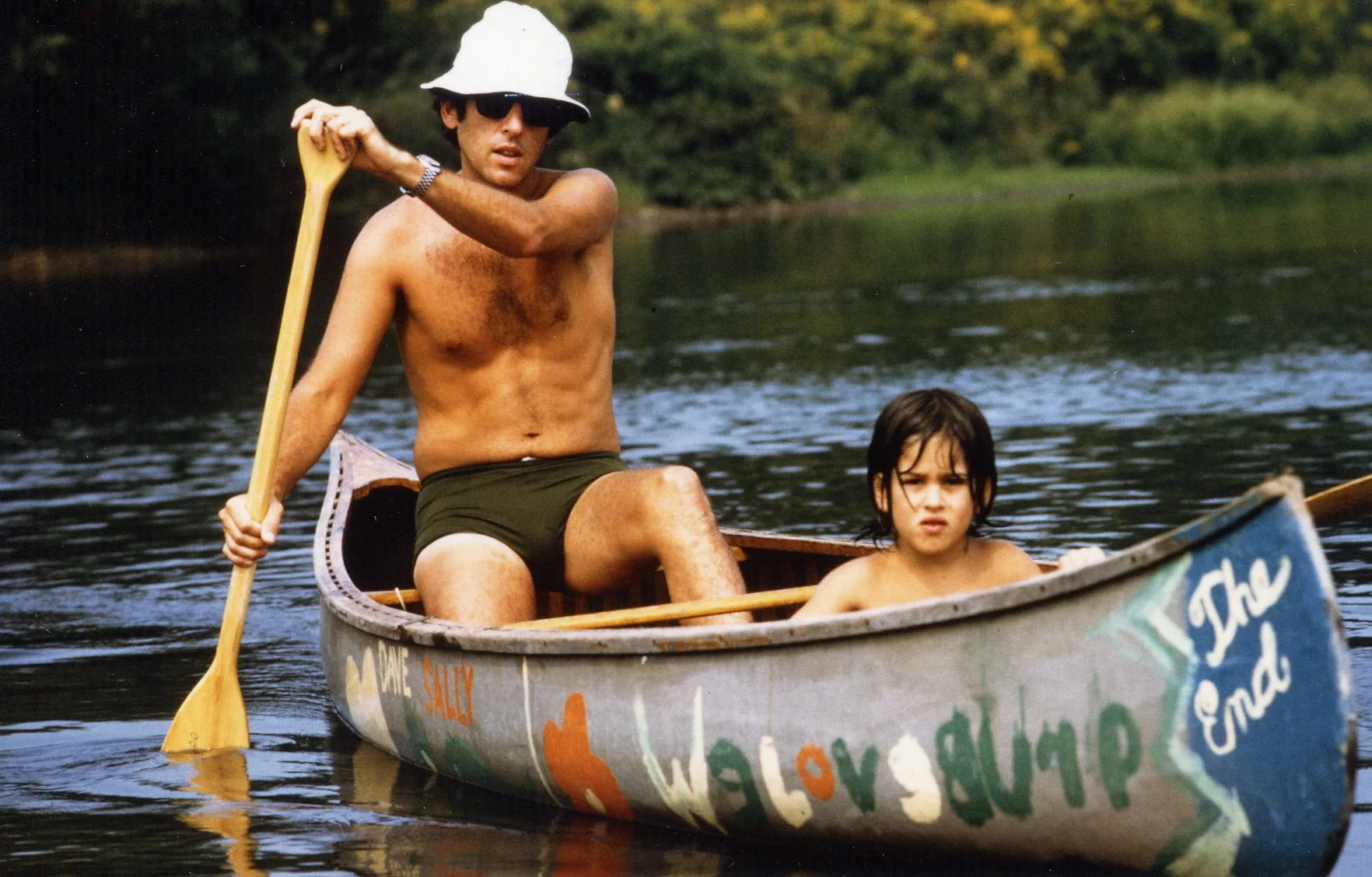
My dad and me, sometime around 1973. I’m about 5 years old, and he’s about 35 in this photo.
His family will remember mud rooms filled with ski waxes and a garage crowded with wetsuits. His restless mind needed these constant activities, but the joy was not in the gear or even the sport. For Michael, the joy was being close to nature: gliding through the quiet of a forested valley blanketed in fresh snow, breaking liquid silver water with a crawl stroke, visiting an old octopus in a cave, dropping anchor in a perfect cove in Desolation Sound. When he and Bonnie found Roberts Creek, BC – with its eagles and Douglas firs, its orcas and snow-capped mountains – they knew they had found a kind of paradise.
He loved goofing with his grandkids, telling them off-the-wall stories and making sure they loved the sea. He was proud to be Anne and Phil’s son, cherished sharing a home with them at the end of their lives, and living surrounded by their art and craft after they died. He respected his parents’ political commitments and stayed true to them. Some of his most recent political work was challenging his fellow doctors to speak out forcefully against the genocide in Gaza, a position that came at the price of some life-long relationships.
His energy was boundless. He fiddled and fixed relentlessly, never buying new what he could patch up for free. He loved to build – family medicine departments, birth rooms, decks, boats, scooters, fences... He treated disability – first Bonnie’s, then his own – as a challenge to meet with ramps, grab bars and gadgets.
He played clarinet for seven decades, jammed on the harmonica and had a beautiful singing voice. A favourite was Old Blue, “you good dog, you,” perhaps because he had a long line of good dogs who joined him in the snow and sea. He loved them all, but none more than his assistance dog Koi, the gentle giant, with whom he had a special kind of bond born of Michael’s own surprising frailty at the end of his life.
Michael suffered from an assortment of neurological conditions over his last years, causing considerable pain, loss of balance, and ultimately great difficulty speaking and moving. As a doctor and researcher, he had spent much of his career solving medical mysteries in others, much like a detective. Yet in a cruel paradox, neither he nor any of his devoted doctors could solve his own. He died at home, surrounded by family and friends.
Those interested in learning more about Michael’s purpose-driven life can do so by reading his 2018 memoir, Dissident Doctor: Catching Babies and Challenging the Medical Status Quo.
Michael leaves behind his wife Bonnie; his children Seth, Naomi and Misha; his daughter-in-law Christine Boyle and son-in-law Avi Lewis; and grandchildren Zoe, Toma, Aaron and Theo.
In lieu of flowers, Michael would have appreciated a donation to one of the organizations he supported, including: